
‘Beasts’ and ‘monsters’: This is how floods such as the German Ahrtal flood are described. Linguist and science communication researcher Brigitte Nerlich explains what kind of metaphors she considers more useful in such contexts – and explains why she currently observes a ‘crisis in crisis communication’.
Foto: Jonathan Ford
“How we talk about a crisis, shapes how we respond to a crisis”

You have been involved in science communication for a long time. Why do you think crisis communication is in crisis?
Clever and timely science communication has become extremely difficult due to the confluence of three factors. First of all, we have accelerated climate change and increasing ocean acidification, and there are almost daily news reports about floods, droughts and hurricanes, that is, extreme weather events.

The second factor is the huge discrepancy between the reality of climate change and the fact that, at the highest level of political decision-making, some people have now adopted the same denialism that I observed 15 years ago. For example, in September there was an extreme weather conference in Hamburg. At the same time, Donald Trump gave a speech at the UN where he talked about a ‘green scam‘ and calls climate change a ‘con job’.
The third factor is the increased use of Artificial Intelligence. The fossil fuel industry has always tried to convince people that climate change doesn’t exist. Now it is using these tools to flood social media with climate disinformation and misinformation. That is something which is really troubling me.
What are your personal experiences with extreme weather events?
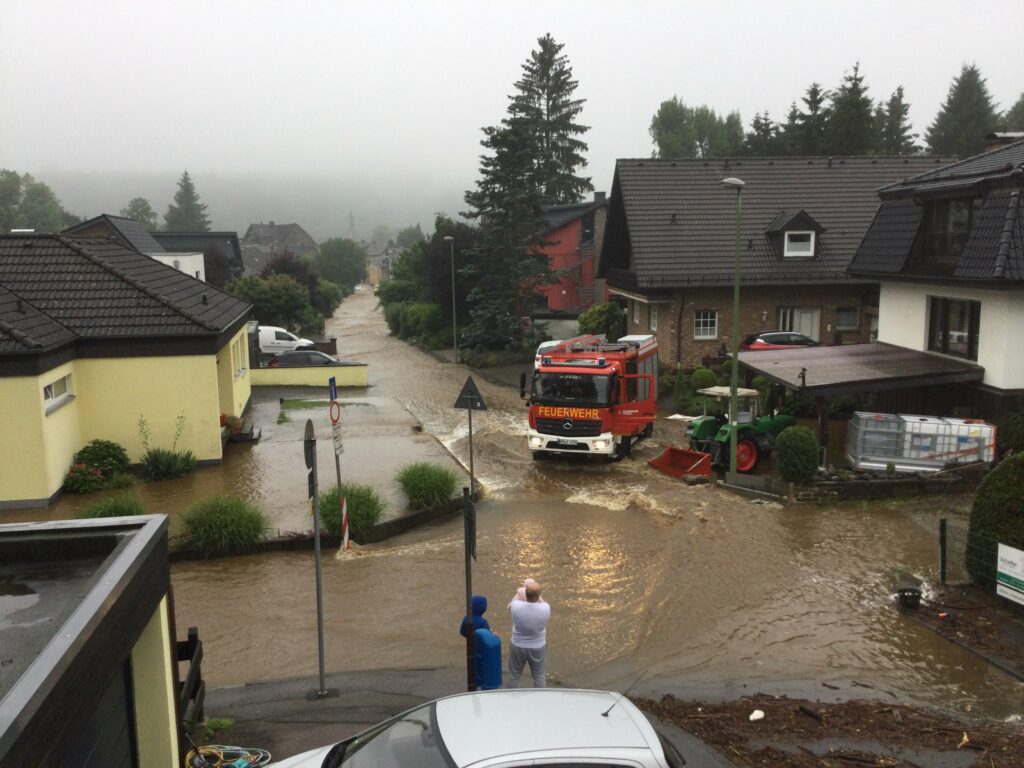
I started thinking about this topic in 2010, after the severe Central European floods and then ten years later during the big 2021 flood in Germany, especially the Ahrtal. I was on holiday in southern England. When I saw on the weather forecast that there was some really bad weather coming towards Germany, I rang my father. But he said: “No, no, we are fine. Nobody is telling us anything.”
The next morning, when I tried to call him, there was no line. The little creek in the German village where my father lived and in which we used to splash about as children, suddenly became a huge river and went through our house and down the road. It was horrible. There was no real warning or crisis coordination. My father was completely unaware of what was happening and I had to gather information piecemeal through social media channels.
A year later, my sister in New Mexico faced huge wildfires and they had to evacuate, but in this case, the communication was brilliant. The authorities informed the communities through all sorts of channels: Twitter, Facebook, community meetings. Everybody knew exactly what to do. Community leaders stressed that there were no ‘silly questions’ and everything was answered. The communication was very timely and respectful. I found these differences in communication styles and information provision during extreme weather events really interesting.
How should the communication look like in these cases? Could we learn anything from the approach in New Mexico?
If possible, national and local governments should provide accurate information from trusted sources including maps and advice on what to do next, where to go for help, advice and shelter. There should be regular updates on multiple platforms, including the Bürgermeister’s (mayor’s) website and Facebook. This platform was effective at a local level, as became clear in the case of my hometown. Community meetings should be held with trusted experts and community leaders. Most importantly, the authorities should listen to and validate the community’s experiences.
Apart from administrative problems, why does it seem so difficult to communicate effectively in extreme weather conditions?
The extreme weather expert Friederike Otto, who set up a big research group called World Weather Attribution (WWA), said after the Valencia floods of October 2024, that it’s very difficult to communicate something that is unimaginable. In Germany, the phrase “das war unvorstellbar” (“that was unimaginable”) was used a lot. That means, what you can’t imagine, you can’t really anticipate or plan for. Extreme weather events have become so varied, so unexpected. The ‘Starkregen’ becomes what metaphorically is called a ‘rain bomb’. And these rain bombs are really difficult to cope with.
Why is it important to look at the metaphors used in such critical situations?
How we talk about a crisis, shapes how we respond to a crisis. Extreme weather events are described through attributing human or animal features to them. Floods and wildfires are described as ‘beasts’ or ‘monsters devouring and ravaging’ a town, as I also observed during the Los Angeles wildfires of January 2025.
In Germany, the word ‘Walze’ (‘steamroller’) was used a lot to emphasize the mechanical force: “Die Flut war eine Walze, die alles niederdrückte.” (“The flood was a steamroller that crushed everything”).
The danger is that hearing something like this makes you really helpless. When the floods become the dominant force, the agency is taken away from humans. That is something which we have to be aware of. Politicians and the media should give people more agency in what they can do against the floods.
You also noticed something you call ‘reverse metaphors’. What do you mean by that?
Sometimes human activities are being reported through the lens of floods. In Valencia, for example, there was talk about ‘floods of volunteers’ and an ‘outpouring of solidarity’. The negative connotations of framing floods as monsters are turned around; what was negative and destructive becomes positive and constructive. That became obvious in the photos picturing armies, indeed floods, of people with their brushes and shovels.
In the aftermaths of floods, you have to deal with huge amounts of mud. In Australia the helpers are sometimes called the ‘mud army’. To focus on their activities is quite encouraging. That gets us a more positive, solidarity-focused framing. I didn’t see that so much in the German case. Instead, the mud metaphor was used to talk about ‘dirty politics’.
An important question is what role climate change plays in such events. How do extreme weather communication and climate communication relate to each other?
After floods and winter storms in England in 2014, the organization Climate Outreach published a book to give advice about when to talk about climate change in the context of extreme whether events. Basically, they said: When the immediate crisis is happening, when houses are flooded and people are shoveling mud, then the focus has to be on safety and immediate needs. In the aftermath of the crisis, you want to blame somebody, you want to recover, you want to overcome your loss.
You must balance long-term communication with urgency and immediate needs. When the crisis has died down and when people begin to ask ‘Is that climate change?’ then it’s the right time to talk about climate change and about how to build up resilience for the next crisis.
Returning to the ‘crisis in crisis communication’: How can climate communicators face the current challenges?
I used to say: You can communicate until the cows come home; it doesn’t change anything if the political circumstances won’t allow practical action. If you are poor or if you are being deported, you don’t think about climate change. Only in a political system where you can afford to think about these topics, can you do it and put up your solar panels, if they are subsidized in a good fashion. That does not mean that one should give up on good science or climate or crisis communication. One just must work harder. And science communicators are doing this even in difficult climatic and political circumstances.
To give an example: The US Department of Energy published a report by a small group of climate change sceptics that concluded that global warming is “less damaging economically than commonly believed”. As soon that the report came out, climate communicators started to dissect this report and told everybody that this information couldn’t be trusted. About a month later, the Trump government withdrew the report. Currently, science communication is no longer just about the dissemination of facts or about public engagement, it’s also about what I call ‘firefighting’ disinformation and misinformation, be it about climate change in general or extreme weather events in part.
Weiterlesen